
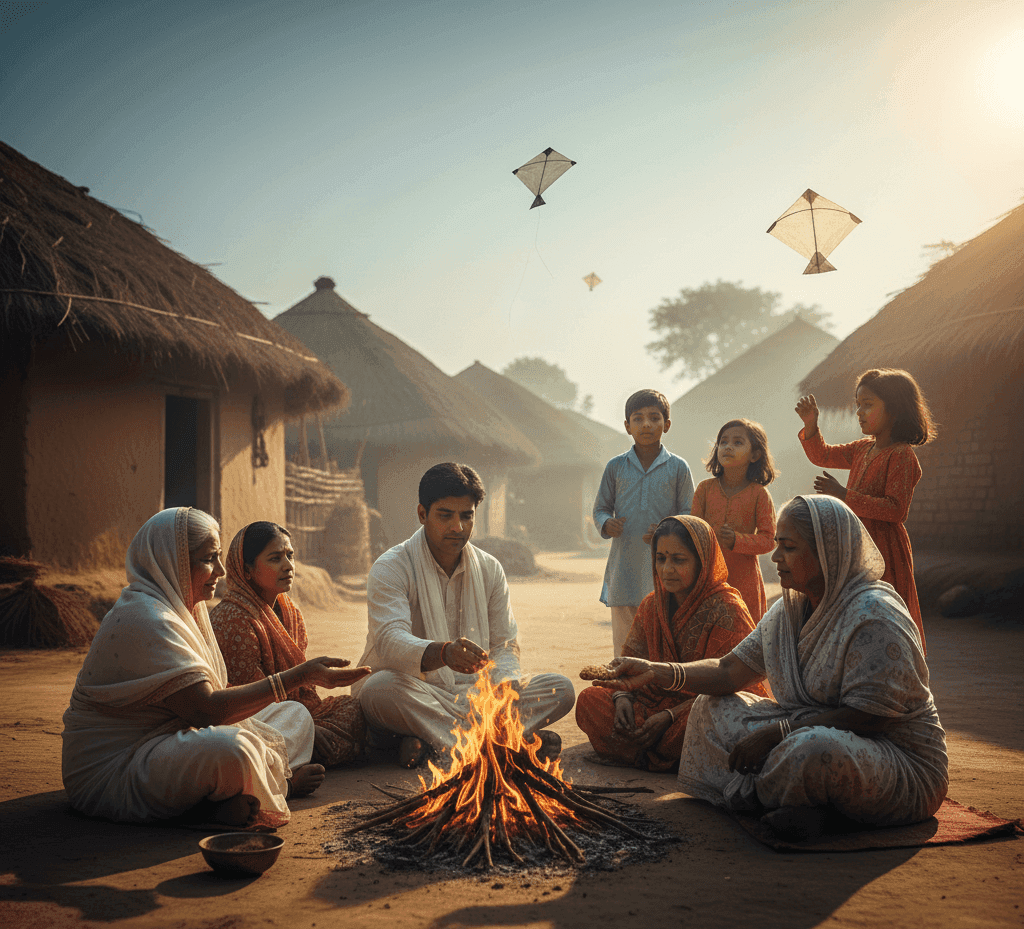
Makar Sankranti feels different in the villages where the festival has not yet become a stage. It is noticed in the way people prepare, not in the way they perform. Signs appear slowly. A rangoli refreshed at dawn. A pot of freshly pounded rice flour is leaning against a doorway. A cart of sugarcane is turning into a landmark on the main road. Nothing announces itself loudly, but everything confirms that Makar Sankranti is coming.
Chettinad, Where Preparations Speak First
In the smaller belts of Chettinad, people do not explain why Makar Sankranti is celebrated because everyone already knows. Children watch for the first batch of sesame sweets drying on steel plates. Women look at the sky before deciding how quickly the fire should burn under the clay stove. Early travelers notice the shift too. Villages begin to smell of ghee and wood smoke in a way that only happens once a year.
Goat farms grow restless. Herds return earlier from the fields as if sensing the days of celebration. Potters set out rows of freshly baked clay pots, their reddish colour deepening in the sun. A traveler walking through these lanes sees no grand performance, only the rhythm of people doing what they have always done. In some homes, elders check old calendars marked with notes about makar sankranti festival is celebrated in which state and how customs vary, but the core never changes. New harvest, new beginnings, new light. Visitors who arrive quietly are treated like familiar company, not spectators.
Kongu Nadu, Where Work Blends With Ritual
In Kongu Nadu, the festival starts with movement. Not with drums, not with decoration. It begins with cows being washed, horns painted with patterns that say more than words. Farmers observing the fields can tell how close the festival is from the softness of the soil and the look of the harvested stacks.
People preparing for Makar Sankranti 2026 will do exactly what their parents and grandparents did. They will check the grains, clean the threshing space, and gather firewood as if the acts themselves are prayers. Visitors who come looking for authenticity find it in these simple gestures. Here, no one asks you to watch. You are expected to stand aside, to notice without interfering. The calm is not staged. The silences between each task say as much as the rituals.
A group of schoolchildren might guide you to the well where turmeric water is prepared. A farmer might invite you to sit under a neem tree while he sharpens his sickle, telling you nothing directly about tradition but showing everything through action. You begin to understand why Makar Sankranti is celebrated without needing a single explanation.

Mandya, Where Cattle Lead the Celebrations
Mandya’s villages become a map of small signs. A rope tied differently on a cattle shed. A trail of kolam stretching farther than usual. A bowl of jaggery is set out for the cows before anyone in the house eats. Bullocks walk with bells that sound older than any story, and travelers who arrive early notice how the whole village watches them, as if the animals hold the calendar in their steps. Elders say you can read the festival in the shine of the cattle coats. That is when outsiders realise this is not a performance. It is a living routine.
A traveler who expects parades finds instead the sound of soaked rice being ground before sunrise. The warmth of fresh sugarcane juice was offered without ceremony. The look of women preparing turmeric threads while talking softly about the coming season. Every action is personal, and yet it is shared.
Coastal Andhra, Where Dawn Carries the Ritual
Coastal Andhra receives the festival with light. Not the decorative kind, but the plain morning sunlight that reflects off the water channels. Fishermen wake before travelers, so visitors sense the festival through movement rather than sight. Boats are cleaned. Nets are repaired. Coconut leaves are tied above doors without fuss. When people speak about Makar Sankranti, they speak in fragments. A grandmother reminds a child not to spill the sesame mix. A neighbour notes the wind direction before drying clothes. A young fisherman chooses the right moment to push his boat into the water. Observers feel the festival through these fragments.
If someone asks why Makar Sankranti is celebrated, they receive answers that sound more like memories than facts. People talk about harvest cycles, old beliefs, family gatherings, and the way the sea seems calmer in January. None of it is a scripted explanation. Everything is instinctive.
Visitors who walk through these coastal villages at dawn see how the festival exists without grand gestures. A freshly swept yard. A rooster crowing earlier than usual. A mother drawing a kolam that fades by noon. These are the real markers, the ones that remain untouched even as bigger towns turn the festival into a spectacle.
Makar Sankranti feels most honest in these pockets of India where the celebration is carried in gestures, chores, and unspoken knowledge, and where the festival reaches travelers gently before they realise they have stepped into it.









